TLDR: The 2026 PH Playbook
Ranking #1 is no longer a simple popularity contest; it is a battle for algorithmic trust. Here is the high-level strategy:
- Weighted Votes: A single "Apex Hunter" vote carries the weight of 50+ new accounts. Identity matters more than quantity.
- Engagement Signals: The algorithm prioritizes "Time on Page." High-quality video assets and automated captions are essential to keep users from bouncing.
- Velocity & Discovery: It’s not about total votes, but how fast you get them via the Homepage, rather than direct links.
- The Comment Multiplier: Real-time engagement and deep thread conversations are the "secret sauce" for triggering a leaderboard surge.
In the high-stakes world of product launches, Product Hunt remains the ultimate "kingmaker." But as we move through 2025, the platform has evolved far beyond the simple "popularity contest" it once was. For the team at startups, understanding the mechanics of this ecosystem isn't just about curiosity—it’s about survival.
If you’ve ever seen a product with 200 upvotes sitting at #10 while a product with 50 upvotes sits at #1, you’ve witnessed the "Black Box" of the Product Hunt algorithm. This guide will pull back the curtain on how that algorithm actually functions today, what a "weighted upvote" truly means, and how you can leverage high-quality video content to trigger the signals that lead to a "Product of the Day" badge.
What is a Product Hunt Upvote? (The 2026 Definition)
In 2025, an upvote is no longer a simple +1. It is a multi-dimensional trust signal. Product Hunt’s engineering team has spent years fighting "voting rings" and bot farms, resulting in a system where the identity of the voter is often more important than the vote itself.
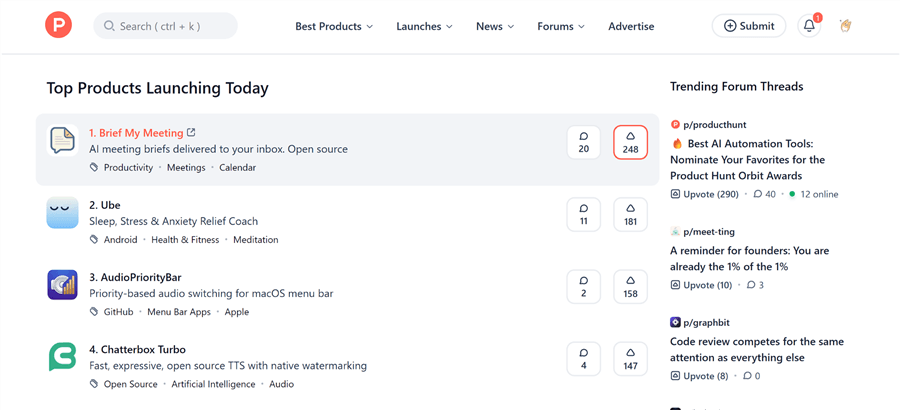
The Hierarchy of Upvote Weight
Not all votes are created equal. Product Hunt assigns a "weight" to every user based on their historical behavior and profile status:
- Verified Power Users (The "Apex Hunters"): These are users with "Phone Verified" badges, high Karma scores, and a history of launching successful products. A single vote from a 2018-era Power User can carry the weight of 30–50 votes from new accounts.
- Active Community Members: Users who log in daily, comment regularly, and have "streaks." Their votes are the backbone of a successful launch.
- The "Newbie" Filter: Accounts created within 72 hours of a launch are often shadow-filtered. This means the upvote count on your page might go up, but your actual ranking on the leaderboard won't budge.
- The "Lurker" Penalty: If a user only ever logs in to vote for one specific product and then disappears, the algorithm eventually devalues that vote as a "suspicious social signal."
The "Reciprocity" Trap
Many founders rely on "support squads"—fellow creators who upvote each other’s work. While community support is the soul of Product Hunt, the algorithm has become hyper-sensitive to "coordinated voting."
One founder recently shared a cautionary tale on r/ProductHunters on Reddit: After reaching 90 upvotes, their count suddenly dropped to 62. Product Hunt support clarified that they removed votes from accounts flagged as "spammers."
This raises a vital human question: Were those 28 people truly spammers, or just fellow hustling creators? To the algorithm, the distinction is slim. To avoid this, your goal shouldn't be "trading votes," but earning them from Verified Power Users who have a history of genuine platform engagement.
How the Product Hunt Ranking Algorithm Really Works
The Product Hunt algorithm is a proprietary blend of automated data processing and human editorial oversight. Here are the four pillars that determine who gets the #1 spot.
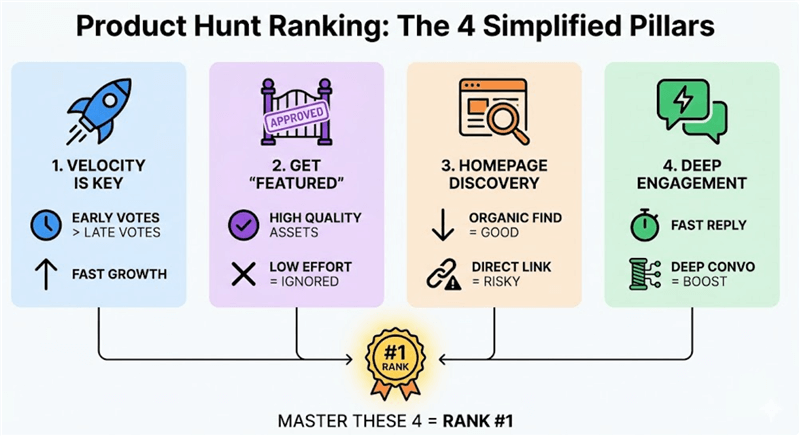
Pillar I: Velocity vs. Volume
Total upvotes are a vanity metric. What the algorithm cares about is Velocity—the rate at which you acquire votes.
- The 4-Hour Window: The first four hours of your launch (starting at 12:01 AM PST) are the most critical. The algorithm looks for a "hockey stick" growth curve.
- Logarithmic Decay: Much like Reddit, Product Hunt uses a decay function. A vote received at 2:00 AM is mathematically more valuable than a vote received at 10:00 PM. To rank #1, you need to maintain a steady stream of "acceleration" rather than one big spike and a flatline.
Pillar II: The "Featured" Gatekeeper (The Editorial Layer)
This is the most misunderstood part of Product Hunt. In 2025, there are two distinct feeds: "Featured" and "All."
If your product is not manually approved by the Product Hunt editorial team to be "Featured," you will stay in the "All" tab. Products in the "All" tab rarely receive significant traffic.
Product Hunt CEO Rajiv Ayyangar points out that there are no "secrets" here: if you aren't featured, it often boils down to three things:
- The description is unclear.
- The unique value proposition isn't obvious.
- The problem doesn't resonate with the community.
- Criteria for Being Featured: Usefulness, novelty, "High Craft" (design quality), and a lack of "spammy" marketing language.
- The Asset Factor: The editorial team looks for high-quality video demos and GIFs. If your gallery looks like a low-effort template, you likely won't cut.
Pillar III: The "Referrer" Signal (Homepage vs. Direct Link)
The algorithm tracks how a user found your page.
- Direct Link (Low Weight): If 90% of your votes come from a direct link (e.g., producthunt.com/posts/poindeo), the system flags you for "coordinated voting."
- Homepage Discovery (High Weight): If a user goes to producthunt. com, scrolls down, and clicks on your product, that is an "organic" signal.
- Strategy: When sharing on social media, tell users: "Find us on the Product Hunt homepage!" instead of giving them a direct link.
Pillar IV: Comment Quality & Maker Engagement
In 2025, Comment Power is the "secret sauce."
- The 10-Minute Rule: Makers who reply to comments within 10 minutes see a measurable boost in their ranking.
- Thread Depth: A comment thread that goes 3 or 4 levels deep (actual conversation) acts as a massive multiplier for your ranking. Simple "Congrats on the launch!" comments are largely ignored.
Debunking 2025 Product Hunt Myths
Myth #1: "Tuesday is the best day to launch."
Reality: Tuesday is the most competitive day. While it has the most traffic, it also attracts the VC-backed giants. If you are a bootstrapped founder using a tool like Poindeo, Weekends are often better for "longevity." You can win #1 with fewer votes and stay on the "Top of the Week" list longer.
Myth #2: "You should buy upvotes to get a head start."
Reality: This is the fastest way to get banned. Product Hunt’s 2025 AI detection (using ensemble learning models) can spot purchased votes instantly by analyzing the social graph of the voters. If 50 people vote for you but none of them are connected in the PH "Orbit," you get flagged.
Myth #3: "The total number of votes determines the winner."
Reality: We’ve seen products with 1,200 votes lose to products with 800 votes. The algorithm prioritizes engagement depth and voter credibility. One "Apex Hunter" vote is worth more than a dozen "new user" votes.
The "PH Video Edge": How to Optimize Your Launch for the Algorithm
On Product Hunt, your video isn't just a demo—it’s an engagement engine. The PH algorithm rewards "Time on Page" and "Interaction Depth." If a user clicks your product and bounces, your rank drops. If they watch a 60-second video, you signal high quality to the system.
Here is how you can use Poindeo to build a video that the algorithm favors:
1. The 3-Second "Retention Hook" (Using Smart Zoom)
The algorithm tracks how quickly users click away. Most creators waste the first few seconds on a logo or intro.
Use Poindeo’s Smart Zoom to immediately focus on your "Magic Moment"—the one feature that solves a pain point instantly.
Don't record a full screen. Upload a high-res screenshot of your UI and use Poindeo to zoom directly into the value-add within 3 seconds.
2. The "Sound-Off" Accessibility Strategy (Using AI Captions)
Data shows that 70% of Product Hunt users browse from work or mobile with the sound off. If your video requires sound to be understood, you lose the majority of your "Time on Page" credit.
Every video must be self-explanatory. So, use Poindeo’s built-in narration feature. Since it generates text directly from your narration, you ensure your value proposition is read even when it isn't heard.
3. High-Resolution "Gallery Gifs" (Using Multi-Ratio Export)
Your primary video is a YouTube embed, but the gallery images are what users scroll through first. High-res, auto-playing GIFs keep the eye moving and increase engagement metrics. Convert your best 5-second feature "highlights" into optimized GIFs.
The Action: Create one project in Poindeo and use the Aspect Ratio tool to export specific feature snippets in 1:1 or 4:3. These smaller, focused clips are perfect for the PH gallery and keep users scrolling through your media assets.
4. The "Comment Teaser" Loop (Using Fast Iteration)
Engagement in the comments section (especially the Maker's Comment) is a primary ranking signal.
Instead of just writing a long text block, post a "Behind the Scenes" or "Easter Egg" video in your first comment.
Use Poindeo to quickly whip up a 30-second "How it started vs. How it’s going" clip on the morning of your launch. This encourages users to stay in the thread, watch the clip, and reply—triggering a "high-engagement" signal to the algorithm.
Bonus Tip: The "Trust & Traction" Framework (Lessons from the Makers)
While the algorithm handles the math, humans handle the momentum. Based on real feedback from successful (and struggling) makers, here are three "secret" levers to pull for a higher ranking:
1. The "Personal Connect" Video
Don't just record a screen share with background music. According to veteran makers, the most successful launches feature a product video with the founder actually in it. * Why it works: It builds an immediate emotional connection and proves a real person is standing behind the product. In an era of AI-generated noise, showing your face is a high-trust signal that encourages "authentic" upvotes rather than drive-by clicks.
2. The "Longevity" Signal (The Roadmap)
A common reason for low engagement is the fear that a product will "launch and disappear."
-
The Strategy: Don't just show what your product does today; list a potential roadmap of the future. When users see a plan for new features, they aren't just upvoting a tool—they are "investing" in the longevity of a project. This shifts the conversation from "Is this cool?" to "I want to see where this goes."
3. The "Pre-Baked" Community
One of the biggest mistakes is launching to a "cold" audience. To avoid being flagged for "spammy" spikes, you need to convert your real-life network into Product Hunt users before launch day.
-
The Strategy: Have your friends and existing users create accounts and engage with the platform weeks in advance. When they support you on launch day, the algorithm sees them as "Active Members" rather than "Disposable Accounts," protecting you from the dreaded "upvote removal" experienced by many founders.
4. The "Job-to-be-Done" Pitch
Stop listing features. Your description and maker comment should focus on the operational, emotional, and social aspects of the problem you solve.
-
The Strategy: Ask yourself: What job is this doing for the user? If you can articulate the "Aha!" moment from a benefits perspective, you'll drive the deep engagement (comments and thread depth) that the 2026 algorithm prioritizes over raw upvote counts.
Your Step-by-Step 2026 Launch Checklist
To rank #1, you need to treat the 24-hour launch window like a military operation.
- Pre-Launch (4 Weeks Out)
- Coming Soon: Launch page early to build Day 1 momentum.
- Karma: Engage daily on PH to build account authority.
- Outreach: Ask 50 niche users for "feedback" on your Poindeo trailer.
- Asset Prep (2 Weeks Out)
- The Video: 60s Poindeo demo (Problem → Smart Zoom Solution).
- Thumbnail: High-contrast animated GIF to stop the scroll.
- The Story: Draft a personal Maker Comment focusing on the "Why."
- Launch Day (24H Sprint)
- 12:01 AM PST: Go live + post Maker Comment immediately.
- 01:00 AM: Activate EU/Asia networks for early velocity.
- 09:00 AM: US "Golden Hour" email and social blast.
- Engagement: Reply to every comment; use mini Poindeo clips for FAQs.
Conclusion
Ranking #1 on Product Hunt is not a fluke—it is the result of mastering the intersection of Community, Velocity, and Visual Quality. By understanding that an upvote is a weighted credit and that the algorithm rewards deep engagement over raw numbers, you can position Poindeo (or any product) for massive success.
Remember: The goal isn't just to be #1 for a day. It’s to use that momentum to build a lasting brand.