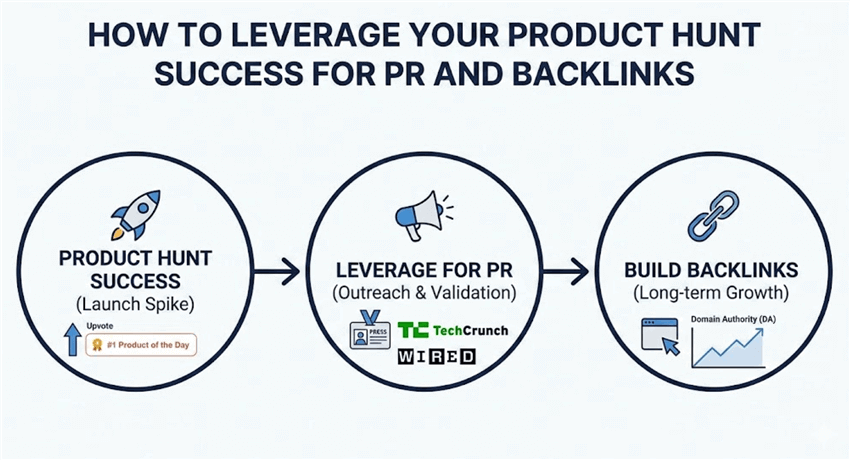
The real value of a Product Hunt win isn’t the 24-hour traffic spike—it’s the "Social Proof" you can now use to scale your organic search authority and PR efforts. To transform a temporary launch into long-term discoverability, you must treat your ranking as a high-value credential to open doors at authoritative tech publications and niche industry sites.
TL;DR: The Post-Launch Framework
- Institutional Validation: Immediately embed your "Top Product" badge on your site and email signatures to boost the reply rates of your outreach campaigns.
- Media Outreach: Pitch your success to tech journalists; a "Top 3 Product" ranking changes your narrative from "just another startup" to "a market-validated solution."
- Link Reclamation: Reach out to niche listicles and directory sites. Use your PH rank as the objective reason why you should be added to their "Best of [Category]" lists.
- Data-Driven Case Studies: Turn your launch data into a blog post. Industry sites love to link to "How we did it" stories, providing you with high-quality, long-term inbound traffic.
Companies like Loom, Notion, and Calendly avoided this by viewing Product Hunt as a catalyst rather than a finish line. They understood that the "Top Product" badge is a powerful negotiation tool. It provides the external validation needed to build long-term search engine presence by knocking on the doors of major tech journalists and high-authority industry bloggers.
This guide dissects the exact framework for transforming your 24-hour win into a decade of compounding organic growth.
The "Product Hunt Hangover" and the Shift to Authority Mode
The "Product Hunt Hangover" is a quantifiable event. Data suggests that referral traffic from PH typically drops by 90% within 48 hours of the launch. If your growth strategy ends at the 24-hour mark, you have essentially "rented" an audience rather than owning a market position.
To move from Launch Mode to Authority Mode, you must extract the three critical "ingredients" your PH success provided:
- Referral Signal Momentum: You have just sent a massive signal to search engine crawlers that a diverse range of high-authority IPs (Product Hunt users) is interested in your domain.
- The Social Proof Bridge: You have solved the "nobody knows us" problem. You are no longer a "random startup"; you are a "Product of the Day" winner.
- Search Intent Discovery: Your comment section is a goldmine. The questions users asked during the launch are the exact "long-tail keywords" you need to target in your post-launch content strategy.
The goal of this blueprint is to use these ingredients to build Domain Authority (DA). In a world where AI-generated content is flooding the web, "Proof of Success" is the only currency that still carries weight with both human editors and search algorithms.
Step 1: Turning Validation into a "Digital PR" Machine
Journalists at major outlets, such as TechCrunch, The Verge, or Wired, are inundated with hundreds of "we just launched" pitches every day. Most are ignored because they lack external validation and, frankly, they are visually boring. Your Product Hunt ranking provides validation; now you need a medium that forces an editor to take notice.
1. The "Social Proof" Press Kit: From Static to Dynamic
Static screenshots of upvote counts and PDF media kits are no longer enough. In 2025, digital PR is moving toward "Proof of Experience." When a journalist visits your site, they need to see that your product isn't just a conceptual landing page—it’s a functioning solution with an active, thriving community.
Most founders stop at taking a screenshot of their Product Hunt leaderboard. However, Poindeo—a browser-based video creation tool—is uniquely designed to turn these static assets into professional-grade stories. Instead of a flat image, you can import your PH screenshots, PDF media kits, or feature graphics into Poindeo and transform them into a guided "Success Recap."
Tactical Execution: Use Poindeo to narrate your media assets. You don't need the design skills of a professional editor or the steep learning curve of traditional software. With simple zoom effects and text annotations, you can lead a journalist’s eye to your most impressive metrics or "Top Hunter" testimonials. It eliminates the complexity of video editing, allowing indie developers and marketers to produce polished product walkthroughs in minutes, ensuring your "Social Proof" feels alive and breathing, not frozen in a PNG file.
2. The "Founder’s Story" Video Pitch: The Human Connection
The "wall of text" email is a relic of the past. If you want a backlink or a feature story from a high-authority site, you must offer a human connection. Journalists respond to faces, movement, and clarity. A personalized video pitch reduces the "scam factor" often associated with new software and immediately builds E-E-A-T (Experience, Expertise, Authoritativeness, and Trust).
The Strategy: Instead of a generic YouTube link, record a 30-second personalized pitch that focuses on enhancing what you already have. By showing your face and your product simultaneously, you humanize the brand while proving the product’s utility in real-time.
Tactical Execution: Using Poindeo’s simultaneous screen and camera recording, place yourself in the corner of the frame to build rapport. If you are pitching a journalist who covers "Creative Tech," use the real-time zoom feature to focus on the specific UI element or noise-reduction tool they’ve complained is missing in other products.
Because Poindeo focuses on guiding the story—using automatic captions and narration for images—you can create a professional-looking pitch that looks like it took hours to edit, even if it only took you five minutes in your browser. This level of polish signals to an editor that your startup is professional, serious, and ready for a global stage.
Step 2: The Backlink Magnet Strategy (Content Repurposing)
Backlinks are the "votes" of the internet. While a link from Product Hunt is valuable, the links you get from people discussing your launch are what truly move the needle for your natural search rankings.
1. The "Data-Driven" Retrospective
One of the highest-performing content types for organic growth is the "Launch Post-Mortem."
- The Content Gap: Most founders write boring "Thank You" posts. To win backlinks, your post must be utilitarian.
- What to Include: Share your conversion rates, your server load struggles, your "Hunter" outreach scripts, and even your failures.
- The Result: Other founders and marketing agencies will link to your post as a "Case Study" or a "How-to Guide." These are high-relevance, "contextual" backlinks that search engines value above all else.
2. Capturing the "Alternative To" Traffic
During your launch, users likely compared you to established giants. “Is this like Loom?” “Is this a better version of Camtasia?” Do not shy away from these comparisons; lean into them.
Create "Comparison Pages" immediately (e.g., YourProduct vs. The Competitor). These pages target High-Intent Keywords. When someone searches for an alternative to a competitor, they are ready to switch. By providing a clear, visual breakdown of why your product is superior—especially through high-quality video walkthroughs—you keep users on your site longer, reducing "Pogo-sticking" (where users click a result and immediately leave), which is a major positive ranking signal.
Step 3: Proactive Outreach & Relationship Building
"Link Building" often has a bad reputation because it's associated with spam. In 2025, we must pivot to Relationship Building.
1. The "Best Of" Listicle Outreach
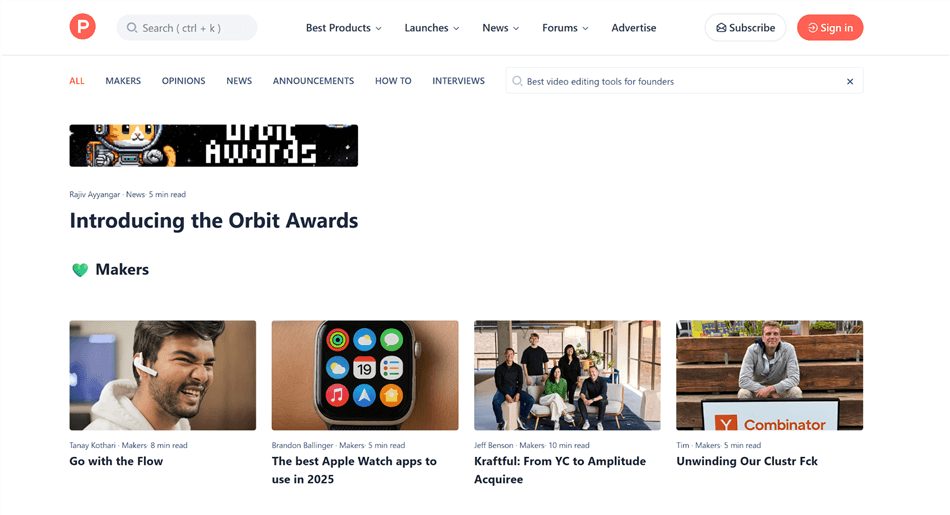
Search for every article ranking in the top 10 for your core keywords (e.g., "Best video editing tools for founders"). These authors are your primary targets.
- The Approach: "I saw your list. We actually just hit #1 on Product Hunt because our users love [Specific Unique Feature]. Would you consider adding us to your 2025 update?"
- The Closer: Include a short, high-definition demo video. If an editor can see the product’s value in 15 seconds without having to create an account, the likelihood of being included in their article increases by over 400%.
2. Guest Posting with a "Trend" Focus
Use your PH success to pitch guest posts to sites like Forbes, Fast Company, or niche SaaS blogs.
Do not write about your product. Write about the industry trend your product represents. If you have a video tool, write about "The Death of Static Communication." Within the author bio or the body of the article, you can link back to your "PH Success Story" blog post, passing significant authority from a high-DA site to yours.
Step 4: Technical Search Optimization (The "Link Juice" Retention)
This is the most critical technical section. If you ignore the backend, you will "leak" all the authority you’ve worked so hard to build.
1. The 301 Redirect Strategy
Many founders create a custom landing page for the launch (e.g., site.com/producthunt). Many external sites and blogs will link directly to this URL.
- The Danger: If you delete this page after your 20% discount offer expires, you lose 100% of the backlink authority those sites were sending you.
- The Fix: Once the campaign is over, use a Permanent 301 Redirect to point that URL to your main homepage or a core feature page. This ensures that the "Link Juice" is transferred to your primary domain rather than disappearing into a "404 Not Found" error.
2. Internal Link Optimization
Your "Product Hunt Success" blog post is likely to become one of your most-linked-to pages. You must use this page as a "Distribution Hub." Place internal links within the post, pointing to your most important commercial pages. Use descriptive anchor text (e.g., "how to record a screen" or "AI video editing"). This tells search crawlers exactly which pages on your site are the most important to rank.
3. Video Schema: The Rich Snippet Secret
Search engines are becoming "Visual First." For every demo video you embed in your post-launch content, you must use VideoObject Schema.
Why? This allows your video to appear in the "Video" tab of Google results and provides "Rich Snippets" (thumbnails) in the main results page. Rich snippets can increase your Click-Through Rate (CTR) by up to 30%, which is a powerful signal to the algorithm that your content is high-quality.
Step 5: Converting "Warm" Leads into Long-term Advocates
Search Discoverability is no longer just about keywords; it is about user satisfaction signals.
The "We Heard You" Feedback Loop
Go back to your Product Hunt comments. If a user requested a feature, and you build it, tell them. Record a quick update video and reply to their original comment.
This creates "Branded Search." When users start searching for your specific product name (e.g., "Poindeo features"), it tells the algorithm that your brand is a standalone authority. Branded search volume is one of the most powerful, yet overlooked, factors in modern digital growth.
The "Community Spotlight" Backlink
Identify a high-profile user who supported your launch. Interview them about their workflow and publish it on your blog. They will naturally want to share this "Spotlight" with their own audience, leading to a high-relevance, organic backlink from a real user’s domain.
Conclusion
Product Hunt is a powerful engine, but an engine is useless without a steering wheel. A successful launch gives you the "Social Proof" and the initial momentum needed to win the PR and Search Discoverability game.
By following this blueprint—turning your upvotes into data-rich content, using professional video demos to humanize your outreach, and managing the technical "Link Juice" of your site—you ensure that your 24 hours of fame turn into years of sustainable, organic growth.
The most effective way to leverage your success is to show, not just tell. In a world saturated with software, the product that can clearly, sleekly, and professionally demonstrate its value is the one that wins the headlines, the backlinks, and the top spot on the search results page.
Ready to turn your Product Hunt success into a permanent growth engine? Start by refining your visual assets and building your PR "Success Recap" today.