By 2026, product marketing will no longer be about persuading buyers that a solution exists. It is about compressing the distance between discovery and value. The strongest product marketing strategies today are designed to minimize Time to Value (TTV) and maximize Feature Adoption, not simply generate awareness or leads.
This article explores what has changed in product marketing strategy, why many old strategies are failing, and how modern product marketers can build a durable, experience-led GTM motion for 2026 and beyond.
Why Many Product Marketing Strategies Fail Today
Many teams still rely on tactics that worked a few years ago, but the environment has shifted. Changes in how users discover products, build trust, and evaluate value have fundamentally altered what effective product marketing looks like in 2026.
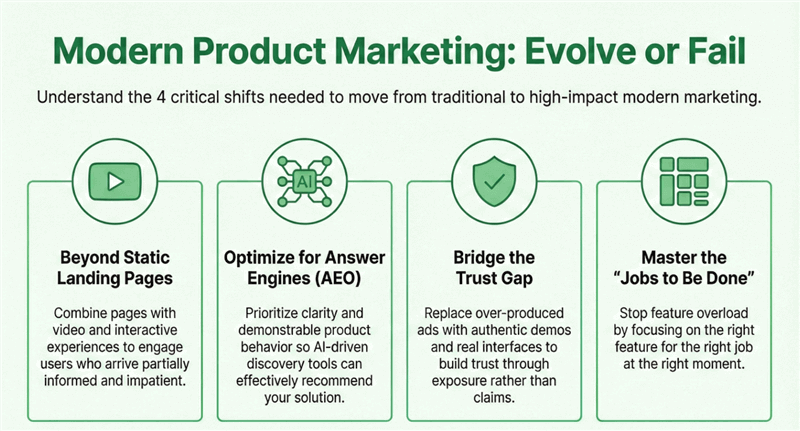
1. Static Landing Pages Are No Longer the First Touchpoint
Landing pages haven’t become irrelevant — they’ve lost their role as the primary place where users form first impressions.
In 2026, initial discovery often happens through AI answers, social feeds, communities, or short-form video. By the time users reach a landing page, they are already partially informed and highly time-constrained. Pages that rely solely on long-form persuasion without demonstration or interaction increasingly underperform.
Landing pages must work in tandem with video and interactive experiences, not operate in isolation.
2. Traditional SEO Has Given Way to Answer Engine Optimization (AEO)
Discovery is shifting from page rankings to AI-generated answers. If a product’s positioning, use cases, and value are not clear enough for AI systems to accurately summarize or reference, visibility drops regardless of keyword coverage.
Product marketing content must be clear, concrete, and grounded in demonstrable product behavior — serving both human readers and AI systems.
3. Polished Brand Messaging Now Faces a Trust Gap
High-production brand messaging no longer automatically signals credibility. In many B2B contexts, it creates distance. Buyers increasingly prefer authentic product demonstrations, real interfaces, and unedited walkthroughs that show how the product actually works.
Trust is built through exposure, not claims.
4. Feature Proliferation Has Diluted Value
As products expanded, marketing often attempted to promote everything at once, leading to feature overload and unclear differentiation.
Modern product marketing prioritizes filtering over amplification — surfacing the right feature for the right job at the right moment in the user journey. This makes Jobs to Be Done (JTBD) a practical necessity, not a theory.
Video as Strategy, Not Just Format
Video is often discussed as a tactic. In 2026, it functions more as a strategic interface between the product and the buyer. Video compresses three critical processes:
- Cognitive understanding – seeing replaces imagining
- Trust formation – transparency reduces skepticism
- Time to Value – demonstration accelerates comprehension
This is especially powerful in early-stage discovery and onboarding, where friction compounds quickly.
Strategy 1. The 60-Second Constraint as a Strategic Discipline
The rise of short-form video has forced clarity. When teams commit to explaining a feature or workflow in under 60 seconds, weak positioning becomes immediately visible.
If a feature cannot be shown clearly in that time frame, the issue is rarely complexity—it is usually unclear value framing.
The constraint becomes a forcing function:
- What is the actual “Aha” moment?
- Which step creates value?
- What can be removed?
This discipline strengthens both messaging and product clarity.
Strategy 2. Replacing Text-Heavy Support with Demonstration
Traditional FAQs assume users are willing to read in moments of confusion. In practice, many users would rather watch a 15-second clip than parse a paragraph.
Embedding short, contextual demos near complex UI elements allows teams to:
- Reduce support tickets
- Increase feature adoption
- Encourage self-service learning
This doesn’t eliminate documentation—but it changes its center of gravity from explanation to illustration.
Strategy 3. Interactive Demos and Time to Value
Interactive demos allow users to experience value before committing. When implemented thoughtfully, they reduce perceived risk and accelerate activation.
However, interactive experiences work best when tightly scoped. The goal is not to simulate the entire product, but to guide users directly to the core value loop.
In this sense, Time to Value becomes the defining metric—not as an abstract KPI, but as a design constraint for marketing itself.
How to Make Video-First Product Marketing Practical
Recognizing the importance of video-first product marketing is easy. Executing it consistently, without slowing teams down, is where most strategies break.
In practice, video creation is still treated as a separate production process—slow, tool-heavy, and difficult to maintain as products evolve. PMMs often rely on static screenshots, text documentation, or outdated recordings simply because producing new videos feels too costly in time and effort.
For video to function as a true strategic layer, it must be fast, lightweight, and embedded directly into the product marketing workflow.
Poindeo is built to solve this execution gap.
Instead of positioning itself as a traditional video editor, Poindeo focuses on turning existing product assets—such as screenshots, images, PDFs, and simple screen recordings—into short, clear, guided videos. The emphasis is not on cinematic editing, but on helping viewers understand where to look and what matters.
This approach makes Poindeo especially suitable for modern PMM teams, where speed and clarity matter more than polish.
What Poindeo Enables in Practice
Poindeo supports the most common video-first product marketing scenarios with minimal overhead:
- Short Feature Demo Videos: Smart zoom effects and text annotations help highlight the exact interaction or “Aha” moment within a 30–60 second walkthrough.
- UI Explanations and Micro-Guides: Static screenshots or PDFs can be turned into narrated visual explanations, reducing reliance on text-heavy documentation.
- Fast Iteration as Products Change: Because Poindeo works directly in the browser and builds on existing materials, updating videos after product changes is quick and low-friction.
- Built-in narration, automatic captions, and multi–aspect ratio exports make these videos immediately usable across landing pages, in-app onboarding, help centers, and social channels.
Poindeo reduces Time to Value on two levels. For product marketing teams, it shortens the time between identifying a message and publishing a clear explanation. For users, it shortens the time it takes to understand how a feature works and why it matters.
Essential Product Marketing Tools
Speed is the ultimate competitive advantage in 2026. This toolkit is designed to help you launch faster and iterate with data.
| Category | Recommended Tool | Core Use Case |
| Product Demos | Poindeo | Instant browser-based recording for quick, authentic feature walkthroughs. |
| Market Research | Perplexity/Claude | Instant synthesis of competitor features and user pain points from across the web. |
| Interactive UI | Navattic | Letting users "test drive" the product through guided, clickable tours. |
| Content Ops | Notion + AI | Centralizing the GTM calendar and using AI to draft video scripts and social copy. |
The 7 Steps to a Winning GTM Plan
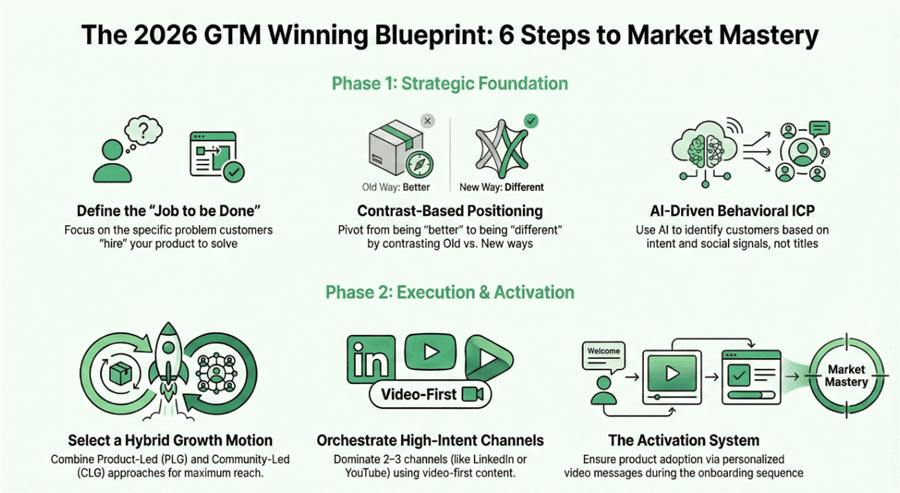
A Go-To-Market (GTM) plan in 2026 is an agile framework, not a one-time event.
- Define the "Job to be Done" (JTBD): Move beyond demographics. Don't ask who your customer is; ask what job they are "hiring" your product to do. Are they hiring you to save them 2 hours of admin work, or to make them look like a hero to their boss?
- Contrast-Based Positioning: In a crowded market, being "better" isn't enough. You must be different. Use a "Narrative of Contrast": explain the "Old Way" (expensive, slow, manual) vs. the "New Way" (your product).
- Identify the "True" ICP via AI: Use AI tools to analyze social signals and community discussions. Your Ideal Customer Profile (ICP) in 2026 is defined by behavioral intent, not just job titles.
- Select Your Growth Motion: Will you be Product-Led (PLG), where the product sells itself via a free trial, or Community-Led (CLG), where you build authority in niche Discord or Slack groups? Most 2026 winners use a hybrid approach.
- The Messaging Architecture: Create a tiered messaging system. One "Core Story" for the brand, and 3-4 "Value Pillars" tailored to specific use cases.
- Channel Orchestration: Don't try to be everywhere. Pick 2–3 high-intent channels (e.g., LinkedIn for authority, YouTube for discovery) and dominate them with video content.
- The Activation System: The GTM doesn't end at "Sign Up." Your plan must include an onboarding sequence that uses personalized video messages to ensure the user actually uses the product.
FAQs about Product Marketing Strategy
How often should we update our product marketing strategy?
In 2026, you should review your messaging every quarter. Markets move too fast for annual plans. Use real-time feedback from your video engagement and feature adoption metrics to tweak your narrative.
Do I need a professional video team to follow the "Video-First" strategy?
Absolutely not. In fact, authentic, "raw" recordings often perform better than over-edited commercials. A clear browser recording with a voiceover (using Poindeo) feels more trustworthy to a 2026 buyer.
What is the most important KPI for a Product Marketer in 2026?
While revenue is the goal, the leading indicator of success is Feature Adoption Rate. If users aren't using the features you are marketing, your positioning is misaligned with their actual needs.
What role does AI play in modern product marketing strategy?
AI is no longer just a research assistant. It shapes discovery, evaluation, and visibility. Product marketing content must now be structured clearly enough for AI systems to summarize, cite, and recommend. This is why concepts like Answer Engine Optimization (AEO) and clear, demonstrable value narratives have become central to strategy.
What is the most common mistake teams make with product marketing?
The most common mistake is trying to say too much at once. Feature-heavy messaging, overloaded landing pages, and unfocused demos dilute impact. Effective product marketing in 2026 is about filtering—showing the right message to the right user at the right moment.
Conclusion
The era of "set it and forget it" marketing is over. As we move through 2026, the role of the Product Marketer is to be a master of narrative and speed. By prioritizing video-first engagement, leveraging AI for intelligence, and focusing on the immediate value you provide to the user, you can turn your product from a "nice-to-have" into an essential part of your customer's workflow.
Ready to start? Don't wait for a perfect script. Open Poindeo, record your product’s best feature in under 60 seconds, and share it with your audience today. That is the first step toward a winning 2026 strategy.